FAQ

FAQS

Learn more about Wayne Countywide Transit
Learn more about voting

  • July 25th: Early In-Person Voting Begins
  • August 2nd: Last Day of Early In-Person Voting
  • August 4th: Election Day

Does my community currently have SMART bus service?

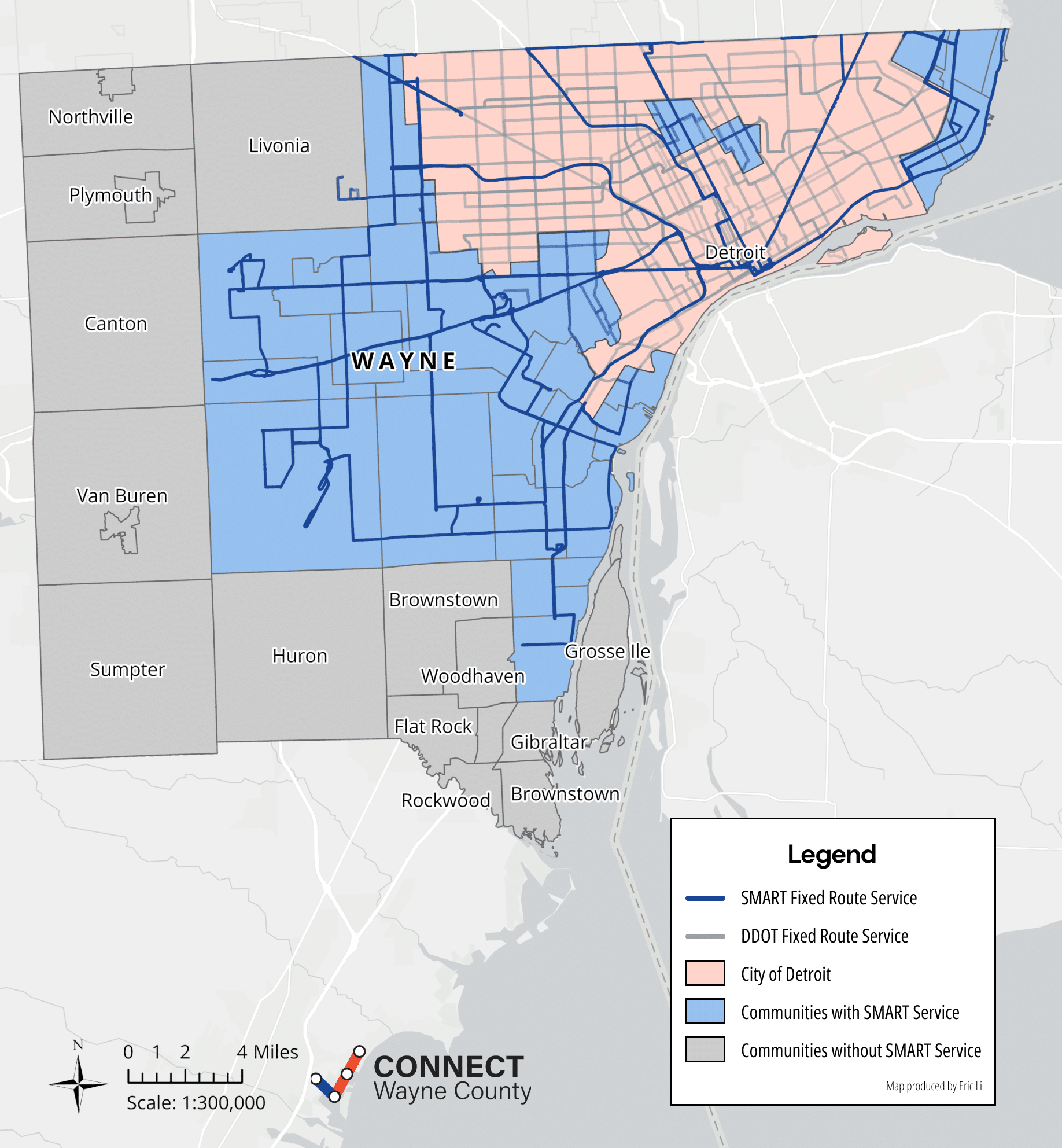
  • Most areas in Central Wayne County, Upper Downriver areas, and some areas near the airport have SMART bus and paratransit service. Many have dial-a-ride service as well:
  • Allen Park, Dearborn, Dearborn Heights, Ecorse, Garden City, the Grosse Pointes & Harper Woods, Hamtramck, Highland Park, Inkster, Lincoln Park, Melvindale, Redford, Riverview, River Rouge, Romulus, Southgate, Taylor, Trenton, Wayne, Westland, Wyandotte.
  • Many Western Wayne, Lower Downriver, and SW Wayne communities do not have SMART bus service. These include:
  • Brownstown, Canton, Flat Rock, Gibraltar, Grosse Ile, Huron Twp., Livonia, Northville, Northville Twp., Plymouth, Plymouth Twp, Rockwood, Sumpter Twp, Van Buren, Van Buren Twp., and Woodhaven
  • Detroit receives some SMART bus service, but currently doesn’t pay the transit millage.
Map showcasing where SMART bus routes go within Wayne county, which communities pay for SMART buses, and which suburbs don't have buses

Who would be providing transit to my community?

  • In most communities, SMART will provide a mixture of bus, paratransit, and on-demand Flex services.
  • In Detroit, funding will go towards enhanced DDOT service.
  • In Livonia, Liv&Go may also receive funding to expand their dial-a-ride service.
  • In Canton, Garden City, Inkster, Wayne, and Westland, Nankin Transit may also receive funding for dial-a-ride service.
  • Like in Oakland County, other local community transit providers may receive funding to provide dial-a-ride or paratransit services, which would be integrated to connect to the entire region.

What does the ballot language say?

WAYNE COUNTY PUBLIC TRANSPORTATION MILLAGE

A proposal to authorize the Wayne County Transit Authority to levy a millage for the purpose of funding public transportation services in Wayne County, including operating, maintaining, improving, and expanding transit services; creating and expanding new fixed routes for bus service connecting local communities; expanding transportation services for seniors, veterans, people with disabilities, and the general public to access healthcare, education, and other daily needs. The millage would be levied at a maximum rate of 0.9831 mills (0.98 cents per $1,000 of taxable value) for a period of 10 years beginning with the 2026 tax year levy and ending with the 2035 tax year levy. This millage would replace an expiring millage levied by the Wayne County Transit Authority supporting the Suburban Mobility Authority for Regional Transportation (“SMART”). If this new millage is approved and levied, revenue will be distributed to Wayne County, SMART, Detroit Department of Transportation (DDOT), and other community and regional transit providers. It is estimated that $57,616,329.00 will be collected in the first year.

What does my community get out of countywide transit expansion?

  • Countywide transit will benefit every community in its own way. Every community will receive expanded transit service and/or new connections.Most cities and townships will receive bus service. Many rural and suburban areas will get an on-demand, dial-a-ride service using smaller transit vans.Link people to the what’s in the plan webpage
  • Detroit: Your tax dollars will fund improved DDOT service in the City of Detroit. You’ll also have transit access to more jobs, more schools, more shops, and more doctors as our region’s transit expands.
  • Suburbs with current SMART bus service: You already pay for bus service. You’ll receive expanded connections to more destinations at $0 additional cost for you!
  • Suburban and Rural areas without SMART service: You’ll receive new bus service, senior services, and/or Flex on-demand service funded by dollars raised in your community, for about $8 a month per household.
  • If the vote passes August 4, SMART will further engage community leaders and residents and will do a more detailed analysis to develop the service plan.

My community provides paratransit service for seniors and people with disabilities. How would that service change under the plan?

  • While many towns in Wayne County currently provide a minimal level of paratransit for their residents, most services stop within a mile of the city line. Some run for only a couple hours a day or only a few days a week. None of these services run on weekends either.
  • Service would greatly improve under the Wayne County Transit Authority. This occurred in 2022 with the Oakland Countywide transit expansion millage, which succeeded. Running paratransit service in partnership with SMART instead of alone results in:
  • Service across township lines is improving, as every provider will be working together. Currently, many services end within township boundaries Increased service hours. Now, all rural areas in Oakland County have transit from at least 7am to 5pm, everyday of the week. Some areas have paratransit service as late as 10pm, and as early as 5am.
  • Increased service hours. Now, all rural areas in Oakland County have transit from at least 7am to 5pm, everyday of the week. Some areas have paratransit service as late as 10pm, and as early as 5am.
  • More flexibility. Seniors went from needing to schedule travel one to two weeks in advance, to a couple days in advance. This gives riders way more flexibility.
  • Expanded access. Due to increased resources, most of these services are open to any resident, not just seniors or people with disabilities. This matters for workers who can’t afford to drive, or students who are too young to drive.
  • Increased ridership. The Northern Oakland Transit Agency (NOTA) saw ridership triple after the Oakland millage went into effect in the same geography. This includes growth in newly serviced areas, but also increased growth in their original service area due to greater availability of service.

How many people use SMART buses?

  • Last year, SMART provided nearly 8 million rides (FY2025 ridership, SMART, 2026)!
  • From 2022 to 2026, SMART has seen a 17% growth in ridership as they’ve made bus routes more frequent, reliable, and have replaced low ridership routes with service to popular destinations (Transit in Wayne County, SMART, 2026). Additionally, SMART is actively improving their bus service to provide a more efficient, frequent service for all.

How much will this plan cost me? How much will be raised?

  • If you live in a suburb with SMART bus service, you’ll see more connections with zero tax increase for you.
  • For every $100K in home value, it will cost your family $4 per month. The average household should expect to pay about $8 a month.
  • The plan will, across all rural and suburban communities aside from Detroit, raise roughly $50M annually, all of which will go towards better local transit service. All additional money raised in Detroit, estimated at $7-8 million, will go towards improving DDOT service.

How will the money raised be managed?

The Wayne County Transportation Authority reports to the Wayne County Board of Commissioners, which is elected in each district by the voters (you.) Wayne County collects the taxes and will contract with SMART and other smaller transit agencies to provide service and hold them accountable.
How does the plan benefit me if I don’t ride the bus?

  • Some of us ride transit. All of us need it. We all depend on people who depend on public transit. Even if you never ride, your community benefits.
  • Public transit will provide economic benefits to your community, connect workers to jobs, freedom to get around for people who can’t drive, and will connect the increasing number of young people who don’t drive to your community.

Does Macomb and Oakland have countywide service?

  • Yes! Oakland and Macomb counties have bus service in most inner-ring and middle suburbs, multiple Flex on-demand service zones, and an integrated paratransit system across the entire county.
  • In rural Northern Oakland and Macomb counties, dial-a-ride service that connects to bus routes and nearby areas are provided that is open to all residents, regardless of age, disability, or income. In contrast, all rural dial-a-ride services in Wayne county are only open to older people and people with disabilities.
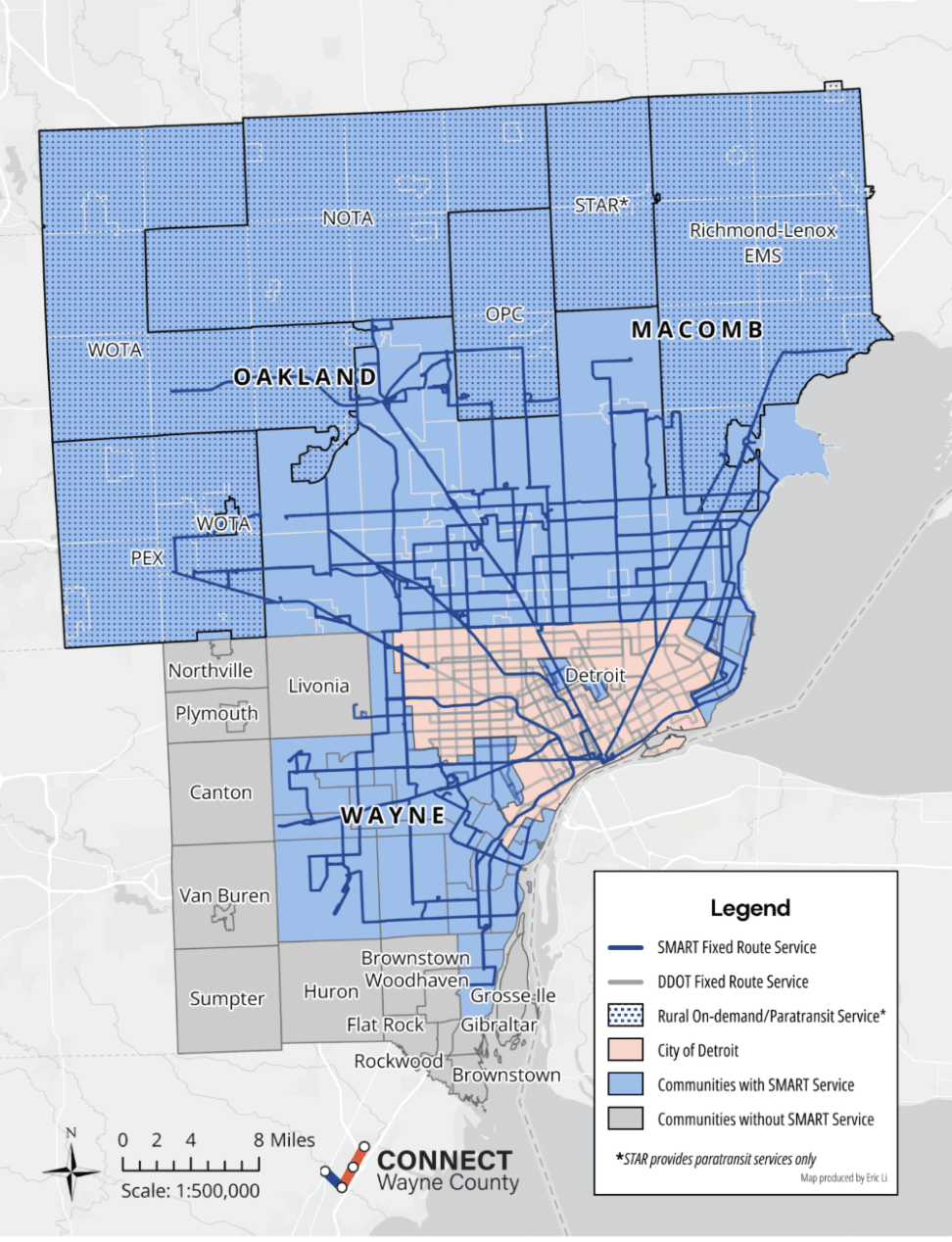
Map showcasing where SMART bus routes go within Wayne county, which communities pay for SMART buses, and which suburbs don't have buses

How does public transit improve community safety?

Transit gives people an affordable, viable travel option when it is time to retire from driving or if they’re temporarily unable to drive due to injuries or consumption. Statistically, you’re ten times less likely to get in a crash if you’re on a bus, as opposed to a car.

Get Involved

Stay informed, volunteer, and help build a more connected Wayne County.